Henry Montagu Butler
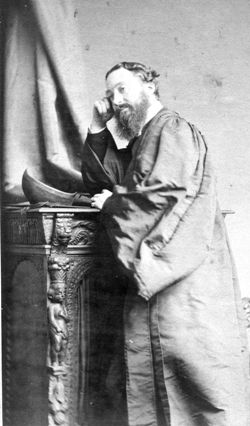
1833-1918. Master, D.D., Classicist, Vice-Chancellor; Chaplain to George V.
Montagu Butler was the son of a Headmaster of Harrow School, where he was educated before going up to Trinity. His second wife, Agnata Frances Ramsay gained the highest marks in the Classical Tripos at Cambridge in 1887. He had two sons and three daughters by his first wife, and another son by his second wife – the historian Sir James Butler. A talented and versatile Latinist, Butler achieved fame as one of the most adept British composers of Latin (and Greek) verse in the 19th and 20th centuries.
Like his father he was headmaster of Harrow, before being appointed Dean of Gloucester Cathedral in 1885 and also Master of Trinity from 1886 to 1918, and Vice Chancellor of the University, 1889-1890. As headmaster, he influenced many young people, including Stanley Baldwin (Prime Minister); Lord Davidson (Archbishop of Canterbury); and bishops, judges, viceroys, governors, ambassadors, privy councillors and generals. Butler wrote the hymn, Lift up your hearts! We lift them, Lord, to thee.
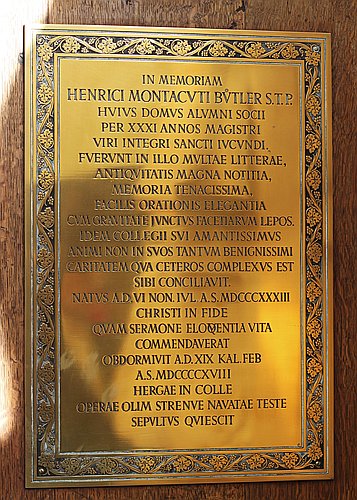
Memorial inscription
IN MEMORIAM
HENRICI MONTACVTI BVTLER S.T.P.
HVIVS DOMVS ALVMNI SOCII
PER XXXI ANNOS MAGISTRI
VIRI INTEGRI SANCTI IVCVNDI.
FVERVNT IN ILLO MVLTAE LITTERAE,
ANTIQVITATIS MAGNA NOTITIA,
MEMORIA TENACISSIMA,
FACILIS ORATIONIS ELEGANTIA
CVM GRAVITATE JVNCTVS FACIETARVM LEPOS.
IDEM COLLEGII SVI AMANTISSIMVS
ANIMI NON IN SVOS TANTVM BENIGNISSIMI
CARITATEM QVA CETEROS COMPLEXVS EST
SIBI CONCILIAVIT.
NATVS A.D.VI NON.IVL. A.S.MDCCCXXXIII
CHRISTI IN FIDE
QVAM SERMONE ELOQVENTIA VITA COMMENDAVERAT
OBDORMIVIT A.D.XIX KAL.FEB A.S.MDCCCCXVIII
HERGAE IN COLLE
OPERAE OLIM STRENVE NAVATAE TESTE
SEPVLTVS QVIESCIT.
Translation
In memory of Henry Montagu Butler, D.D., who was an undergraduate, a Fellow, and for thirty-six years Master of the College. An upright, pious and cheerful man, he had a wide knowledge of literature, a great understanding of antiquity, a tenacious memory, and an easy and elegant style of speech; the charm of his wit was tempered with seriousness. He greatly loved his College, and he was of a kindly disposition not only towards his own friends; he drew to himself the affection with which he treated others. He was born on 2nd July 1833 and died on 14th January 1918, professing the Christian faith, which he had promoted by his sermons, his eloquence and his life. He is buried at Harrow on the Hill which was witness to work manfully undertaken.
Brasses located on the north wall of the Ante-Chapel. Inscription texts by H.M. Butler (below) and A.E. Housman (right).