Isaac Newton
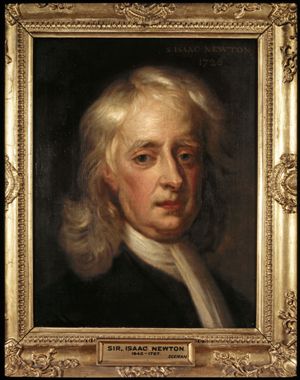
1642-1727. Physicist, mathematician, astronomer, natural philosopher, alchemist, and theologian. Newton was the greatest English mathematician of his generation. Developing Isaac Barrow’s work he laid the foundation for differential and integral calculus. His work on optics and gravitation make him one of the greatest scientists the world has known. His monograph Philosophiæ Naturalis Principia Mathematica, published in 1687, lays the foundations for most of classical mechanics. In this work, Newton described universal gravitation and the three laws of motion, which dominated the scientific view of the physical universe for the next three centuries. Newton showed that the motions of objects on earth and of celestial bodies are governed by the same set of natural laws, by demonstrating the consistency between Kepler’s laws of planetary motion and his theory of gravitation, thus removing the last doubts about heliocentrism and advancing the scientific revolution.
The Principia is generally considered to be one of the most important scientific books ever written, due, independently, to the specific physical laws the work successfully described, and for the style of the work, which assisted in setting standards for scientific publication down to the present time. Newton built the first practical reflecting telescope and developed a theory of colour based on the observation that a prism decomposes white light into the many colours that form the visible spectrum. He also formulated an empirical law of cooling and studied the speed of sound. In mathematics, Newton shares the credit with Leibniz for the development of differential and integral calculus. He also demonstrated the generalised binomial theorem, developed Newton’s method for approximating the roots of a function, and contributed to the study of power series. Newton, although an unorthodox Christian, was deeply religious, and wrote more on Biblical hermeneutics and occult studies than on science and mathematics. Newton secretly rejected Trinitarianism, and feared being accused of refusing holy orders.
Some quotations from Newton:
If I have seen further it is by standing on ye shoulders of Giants.
I have not been able to discover the cause of those properties of gravity from phenomena, and I frame no hypotheses; for whatever is not deduced from the phenomena is to be called a hypothesis, and hypotheses, whether metaphysical or physical, whether of occult qualities or mechanical, have no place in experimental philosophy.
To explain all nature is too difficult a task for any one man or even for any one age. ‘Tis much better to do a little with certainty, & leave the rest for others that come after you, than to explain all things by conjecture without making sure of any thing.
To every action there is always opposed an equal reaction; or, the mutual actions of two bodies upon each other are always equal, and directed to contrary parts.
I do not know what I may appear to the world, but to myself I seem to have been only like a boy playing on the sea-shore, and diverting myself in now and then finding a smoother pebble or a prettier shell than ordinary, whilst the great ocean of truth lay all undiscovered before me.
Amicus Plato — amicus Aristoteles — magis amica veritas.
The time times & half time do not end before 2060. … It may end later, but I see no reason for its ending sooner. This I mention not to assert when the time of the end shall be, but to put a stop to the rash conjectures of fancifull men who are frequently predicting the time of the end, & by doing so bring the sacred prophesies into discredit as often as their predictions fail. Christ comes as a thief in the night, & it is not for us to know the times & seasons which God hath put into his own breast.
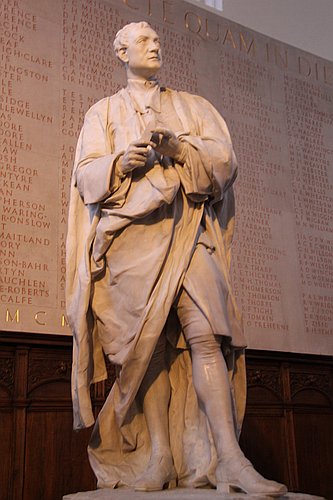
Memorial inscription
NEWTON
Qui genus humanum ingenio superavit.
Posuit Robertus Smith S.T.P.
Collegij hujus S. Trinitatis Magister MDCCLV
L.F. Roubiliac invit et scit.
Translation
Newton: ‘Who surpassed the race of men in understanding’. [Lucretius]
Robert Smith, D.D., Master of this College of the Holy Trinity, placed [this statue] in 1755.
L.F. Roubiliac designed and carved it.
Statue by Roubiliac located in the Ante-Chapel, presented to the College by Robert Smith, Master, in 1755; the cost is recorded to have been £3000. Roubiliac’s statue of Newton “is the finest work of art in the College, as well as the most moving and significant. The lips parted and the eyes turned up in thought give life to marble. The inscription, Qui genus humanum ingenio superavit, is a pun ennobled by its truth”. This inscription is a quotation from the third book of Lucretius’s De rerum natura, meaning ‘in intellect he surpassed / survived the human race’. “The Sir Isaac Newton is the noblest, I think, of all our English statues. There is an air of nature, and a loftiness of thought about it, which no other artist has in this country, I suspect, reached. You cannot imagine any thing grander in sentiment, and the execution is every way worthy of it.” Attributed to the sculptor Sir Francis Chantrey, in Allan Cunningham’s Lives of British Painters, Sculptors and Architects, iii.52. “The statue of Newton in Trinity College Chapel, when first completed, had the mouth closed. Some friend and connoisseur having come to the artist’s studio to view the work immediately remarked this as a defect and expressed his opinion to the artist. Roubiliac went to bed, but could not sleep: he rose early, set to work, and made it what it is at present; and certainly the result of this bold experiment is admirable. The good taste of the artist was not greater than his candour in admitting an error in that stage of his work, or more remarkable than the confidence which he possessed in his own skill to correct it.” The Cambridge Portfolio by J.J. Smith, 1840, p. 204 Tomb in Westminster Abbey.